1. How to Measure Body Fat with Skinfold Calipers — Step-by-Step Guide
Guide

How to Measure Body Fat with Skinfold Calipers — Step-by-Step Guide

Master the Jackson-Pollock 3-site skinfold protocol. Body fat categories, caliper technique, and why tracking changes beats chasing a number.

7 steps~8 min read

How do I measure body fat with skinfold calipers?

To measure body fat with skinfold calipers, use the Jackson-Pollock 3-site protocol: men measure chest, abdomen, and thigh; women measure triceps, suprailiac, and thigh. Take 2–3 readings at each site within 2 mm of each other and average them. The sum of these averages, combined with your age, feeds into the Jackson-Pollock equation to estimate body density, which converts to body fat percentage via the Siri equation. Calipers are most valuable for tracking trends over time — a consistent drop in skinfold thickness is a reliable sign of fat loss, regardless of what the calculated percentage says. Calibr8 has a built-in guided caliper measurement that does all the math for you and uses the result to set more accurate macro targets.

In this guide

  1. 1Choose the right caliper
  2. 2Learn the measurement sites
  3. 3Prepare for consistent measurements
  4. 4Take your readings
  5. 5Understand your body fat percentage
  6. 6Focus on trends, not the number
  7. 7Use your results to guide nutrition
  1. 1

    Choose the right caliper

    Not all calipers are created equal. Research-grade models cost over $200, but for personal use, affordable spring-loaded calipers in the €8–15 range work very well. Look for a model with a reliable spring mechanism that exerts constant pressure across the jaws — this reduces the skill needed for accurate readings. Avoid the cheapest plastic calipers, as their springs weaken over time and introduce drift. What matters most is consistency: different calipers give slightly different readings by design, so once you pick one, stick with it for all future measurements. Same caliper, same technique, same conditions — that is the formula for reliable results.
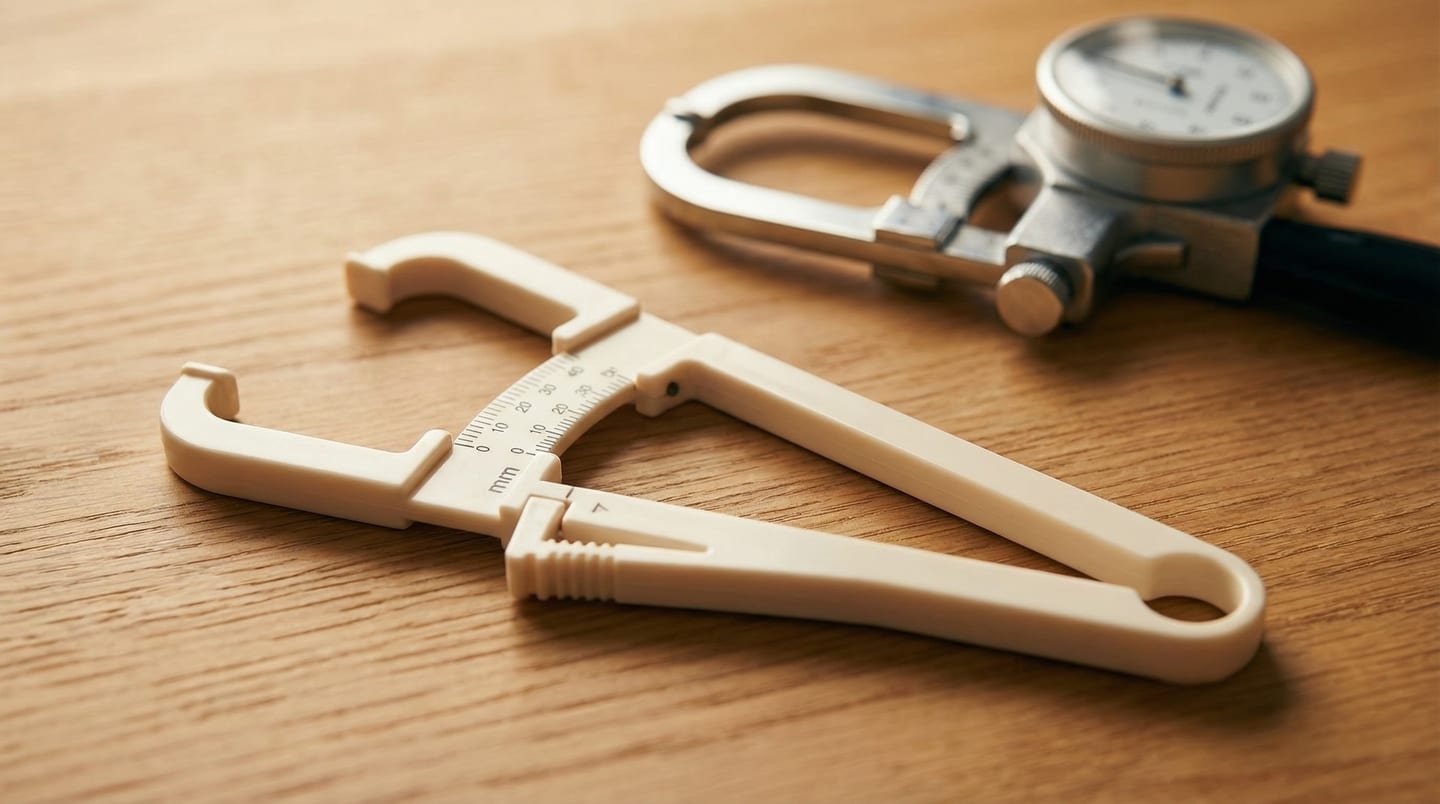
    Comparison of skinfold caliper types: affordable spring-loaded personal caliper next to research-grade caliper
    Comparison of skinfold caliper types: affordable spring-loaded personal caliper next to research-grade caliper
  2. 2

    Learn the measurement sites

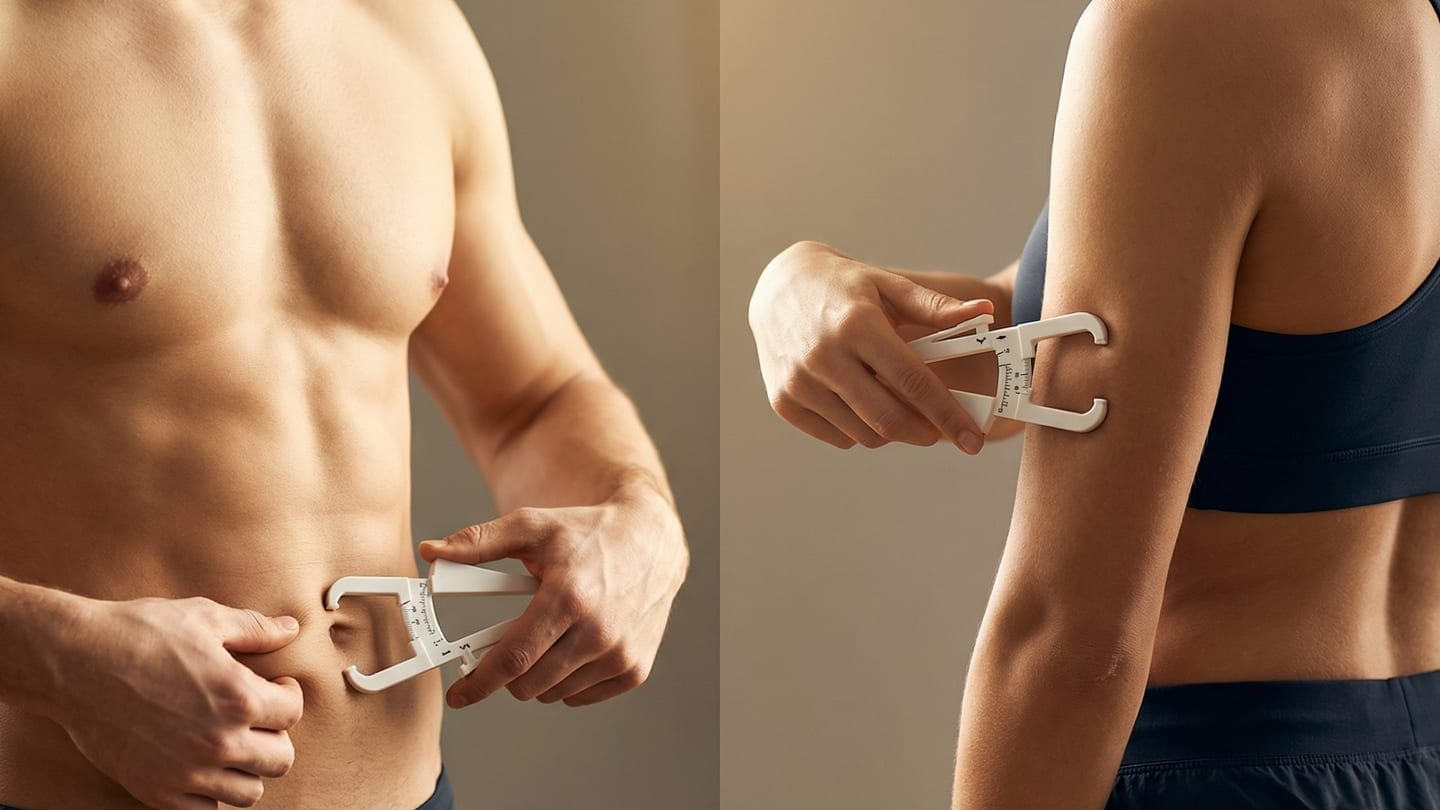
    The Jackson-Pollock 3-site protocol uses different anatomical landmarks for men and women, chosen because these sites best predict total body fat distribution for each sex. For men: (1) Chest — a diagonal fold taken halfway between the nipple and the front armpit crease; (2) Abdomen — a vertical fold taken 2 cm to the right of the navel; (3) Thigh — a vertical fold on the front of the thigh, midway between the hip crease and the top of the kneecap. For women: (1) Triceps — a vertical fold on the back of the upper arm, midway between the shoulder and elbow; (2) Suprailiac — a diagonal fold taken just above the hip bone (iliac crest); (3) Thigh — same as for men. Always measure on the right side of the body for standardization.

    Male and female fitness models demonstrating Jackson-Pollock skinfold measurement sites: abdomen for men, triceps for women
    Male and female fitness models demonstrating Jackson-Pollock skinfold measurement sites: abdomen for men, triceps for women
  3. 3

    Prepare for consistent measurements

    Consistency is everything when it comes to skinfold measurements — small technique variations create bigger differences than actual fat loss between sessions. Measure at the same time of day, ideally in the morning before exercise and on an empty stomach. Blood flow from training temporarily inflates the tissue under the skin, which skews readings. Keep your skin dry (no lotions or oils). If you plan to track progress over months, mark each site with a small washable dot so you measure the exact same spot each time. Always measure yourself (or use the same partner) — different operators can get different results even at the same site. The goal is not laboratory perfection; it is personal repeatability.

    Calibr8 does the math for you

    Automatic macro targets and weekly adaptation based on your real progress.

  4. 4

    Take your readings

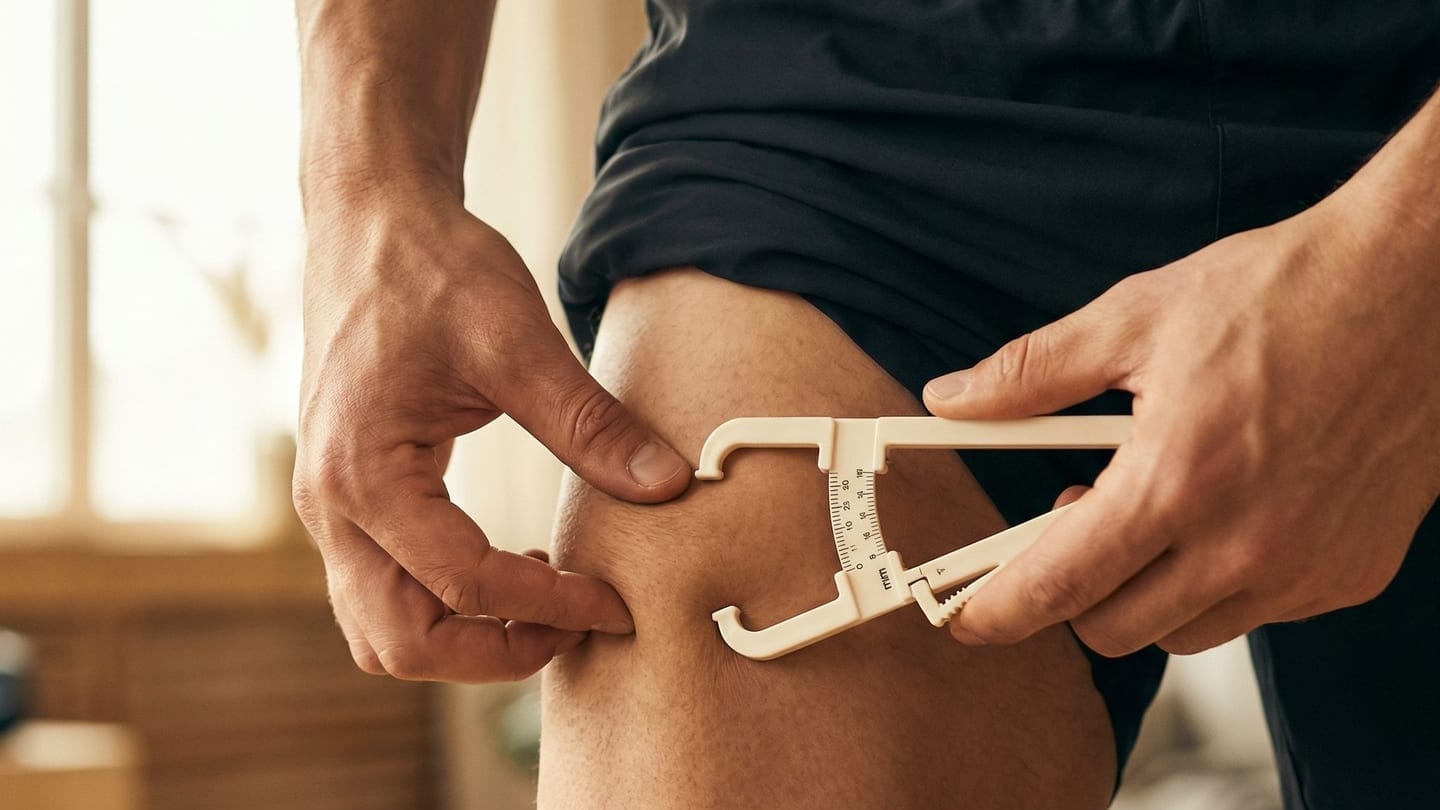
    At each site, grasp a fold of skin and the underlying fat layer between your thumb and index finger — pull it away from the muscle, so you are pinching only subcutaneous fat. Place the caliper jaws about 1 cm below your fingers and let them close fully. Read the measurement 1–2 seconds after release, before the value starts creeping downward (this happens as the caliper compresses the fat). Take 2 readings per site. If they differ by more than 2 mm, take a 3rd reading and average all three. Record each reading in millimeters. The sum of your three site averages is the number that goes into the body fat equation. Taking multiple readings and averaging is the single most effective way to improve accuracy — it smooths out the small pinch-to-pinch variations that are unavoidable even with perfect technique.

    Closeup of proper skinfold caliper pinch technique: two fingers grasping a skin fold with caliper jaws placed 1 cm below
    Closeup of proper skinfold caliper pinch technique: two fingers grasping a skin fold with caliper jaws placed 1 cm below
  5. 5

    Understand your body fat percentage

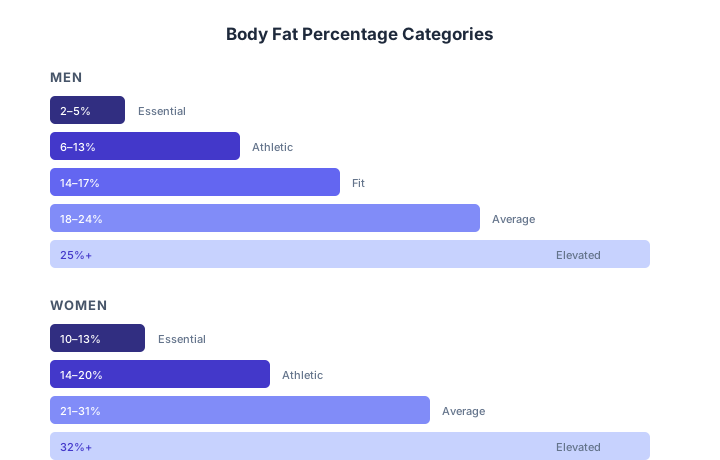
    The Jackson-Pollock equation converts your sum of skinfolds and age into body density, which then becomes a body fat percentage through the Siri equation: BF% = (495 ÷ body density) – 450. Calibr8 does this math automatically when you enter your readings. Here is how the results map to general fitness categories for men: contest-ready below 8%, athletic 8–15%, average 15–21%, above average 21–26%, and significantly elevated above 26%. For women (who naturally carry more essential fat): contest-ready below 14%, athletic 14–24%, average 24–33%, above average 33–39%, and significantly elevated above 39%. These ranges are guidelines, not rigid cutoffs — where you fall depends on your individual goals, training history, and overall health.

    Body fat percentage categories chart for men and women, from contest-ready to elevated, with percentage ranges
    Body fat percentage categories chart for men and women, from contest-ready to elevated, with percentage ranges
  6. 6

    Focus on trends, not the number

    Here is the most important insight that separates informed athletes from everyone else: skinfold equations were developed on general populations and tend to underestimate body fat in trained individuals by 2–5 percentage points. If the equation says 12%, your true value might be closer to 15%. This is normal and expected — the formulas were not designed for muscular physiques. The real power of calipers is in tracking change over time. If your sum of skinfolds drops by 10 mm over 8 weeks, you have lost real fat regardless of what the calculated percentage says. That is a far more actionable signal than a single snapshot. For men, the abdomen and suprailiac sites alone explain over 90% of body fat changes — if those measurements are dropping, you are on the right track. For women, adding thigh measurements rounds out the picture. Measure every 2–4 weeks under the same conditions for the clearest trend line.

  7. 7

    Use your results to guide nutrition

    Your body fat percentage is not just a number on a page — it directly shapes how aggressive or conservative your caloric targets should be. Leaner individuals need smaller deficits during fat loss to protect muscle mass, while those with more body fat can safely sustain larger deficits without the same risk. This same principle works in reverse for gaining muscle: research shows that leaner individuals partition more of their caloric surplus toward lean tissue rather than fat. In practical terms, knowing your body fat category helps you set a deficit size, a maximum rate of weekly weight loss, and a surplus size that matches your physiology rather than following a one-size-fits-all number. Calibr8 uses your caliper measurement (or any body composition method you choose) to automatically calibrate these targets and recalibrate them weekly as your body changes. The guided measurement flow walks you through each site with real-time validation, so you get reliable data without needing a coach in the room.

Frequently Asked Questions

DXA scans have a 1–3% error margin on any single measurement and are heavily influenced by hydration, meal timing, and even electrolyte balance. For a one-time snapshot, DXA provides a reasonable estimate. But for tracking changes week-to-week or month-to-month, calipers are actually more practical because you control all the variables — same operator, same technique, same conditions. The error in calipers is consistent (it skews the same way each time), which means the trend it reveals is reliable even if the absolute number is slightly off. Most coaches and sports scientists recommend calipers over DXA for routine progress tracking for exactly this reason.

Healthy body fat ranges differ significantly between sexes because women carry essential fat in mammary tissue and the pelvic region. For men, the athletic range is 8–15%, the average healthy range is 15–21%, and above 26% is considered elevated. For women, the athletic range is 14–24%, the average healthy range is 24–33%, and above 39% is elevated. Essential fat — the minimum your body needs to function — is approximately 3–5% for men and 8–12% for women. Dipping below these levels compromises hormonal function, immune health, and organ protection. For most people focused on looking and feeling good while performing well in the gym, 12–18% (men) or 20–28% (women) is a sustainable sweet spot.

Self-measurement works well for most sites. The abdomen and thigh are straightforward to pinch and measure with one hand while operating the caliper with the other. The chest site (for men) is manageable solo with a bit of practice. The triceps and suprailiac (for women) can be trickier alone, but many people manage with a mirror and patience. If you do use a partner, always use the same person — different operators consistently get slightly different readings. Consistency between sessions matters far more than having a second pair of hands.

Every 2–4 weeks is the ideal frequency. More frequent measurements add noise without useful signal — your body fat does not change fast enough for weekly calipers to tell you anything meaningful. Always measure under the same conditions: same time of day (morning is best), same hydration state (before eating or drinking), same side of the body, and before any exercise. If you are in a fat loss phase, the trend over 3–4 measurements gives you a clear picture. If you are maintaining or bulking, monthly check-ins are sufficient to confirm you are not gaining unwanted fat.

In most cases, no. Consumer BIA scales (the kind you stand on barefoot) use a single electrical frequency and are heavily influenced by hydration, recent meals, body temperature, and even whether your feet are wet. Day-to-day variance can be 3–5 percentage points, which is often larger than the actual change you are trying to detect. Even higher-end multi-frequency devices like InBody scanners show meaningful day-to-day fluctuations in non-lab conditions. Calipers, when used consistently, produce a more reliable trend line because you control the measurement conditions. They are also cheaper, portable, and require no electricity or software.

This is one of the most common questions, and there is a straightforward explanation. The Jackson-Pollock equations were developed in the 1970s and 1980s on general population samples that did not include heavily trained individuals. As a result, the formulas tend to underestimate body fat in people with significant muscle mass by roughly 2–5 percentage points. If the equation says 10%, you might realistically be closer to 13–15%. This is expected behavior, not a measurement error. The solution is simple: do not fixate on the number. Instead, use the sum of your skinfold measurements (in millimeters) as your primary metric. If that sum is decreasing over time, you are losing fat — period. The trend is the truth.

Related Resources

Browse our food database4,700+ foods with 14 nutrients each
Compare nutrition appsSee how Calibr8 stacks up

Let Calibr8 Calculate Your Macros for You

Evidence-based nutrition that adapts your plan every week. 14-day free trial.

14-day free trial30-day money-back guaranteeCancel anytime
Start Free TrialView pricing
Home
Guides
Start Free Trial
C8
Calibr8
Food DatabaseNutrition GuidesResearch InsightsCompare AppsCommunity

Explore More

Try free
Browse 4,700+ FoodsComplete nutrition data for Bulgarian foods
Science InsightsLatest nutrition research, simplified
App ComparisonsSee how Calibr8 compares to other apps
CommunityEvidence-based nutrition discussions and research insights